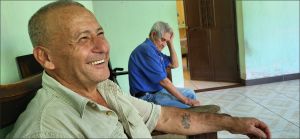
Francisco is quick to smile, and generous with what little he has. He shares his time and food with the nuns at the elder care home.
His first wife died many years ago, after giving birth to seven healthy children who are all grown now. He remarried a short time later, and always checks with his wife before donating any food to the elder care home.
Francisco has told me he may not be able to come out every week to work in the garden, so he plans to find others who can help. Our goal is to increase the size of the garden, so that those community members who help us can be paid with food to feed their families.
To truly understand the story behind this handsome man with the generous heart, we need to have a look at his tattoo.
There is a story behind that tattoo.
Let’s talk about the bloody, 36-year civil war in Guatemala. Let’s talk about how the U.S. started and perpetuated this war that killed 200,000 people, most of whom were Mayan. The war displaced up to a million more, and horrific crimes were committed against the people of Guatemala. I’m sure a few of you will unsubscribe from this email list right about now (if not now, then by the end of the email here), and that’s fine.
My goal is to help people understand the struggles that this country continues to endure in its efforts to recover from the poverty and anguish inflicted on it over the course of generations. I want to explain what these elders, and those who care for them, have endured. And I want to explain why we are working to repair the damage that was done, even if we can only repair one little bit at a time.
As I’ve mentioned before, Guatemala was working towards a more democratic and inclusive society when, in 1954, the democratically-elected, reform-minded President was overthrown. The U.S. government led this coup because our corporate interests (fruit companies) were threatened by the reforms this new president promised his beleaguered people. The U.S. played a role every step of the way in this bloody war. We even chose a Guatemalan man, who’d trained here in Kansas, to lead the coup. Horrific human rights abuses ensued, year after year after year, with the U.S. turning a blind eye to the Catholic priests and nuns being slaughtered and even the entire Mayan villages being wiped out by the Guatemalan military — all because we wanted to protect our corporate interests. We kept funneling guns and money into the Guatemalan military, and even supported multiple paramilitary death squads that popped up. (In all fairness, President Carter tried to stop the war.)
Fighting for the rights of the Guatemalan people, and for the Mayan people who were being decimated, were the guerillas. They fought with their heart and soul to protect themselves against the threats that came from all around.
The early 80s were the bloodiest years of the war, with unspeakable atrocities committed upon the Mayan people, and those who were perceived as supporting the guerillas.
When I asked Francisco about his tattoo, he mentioned that “the soldier needed to be marked in the war.”
“I fought,” he said, “let’s say, with — in favor — of the guerilla. The soldier needed to be marked with his heart.” The tattoo meant others could tell which side he was on. “He can’t fight on both sides,” Francisco said. “Not that he is okay with one [side] and then the other [side].”
I asked him what he thought about the new president, Bernardo Arévalo, who promises the same reforms and democratic inclusiveness that Jacobo Árbenz promised in 1954 before the Western world interrupted Guatemala’s progress.
“We hope that it will be the best, because of what has been,” he replied. “We continue to wait, and to hope for him to be there, to do something for us, those of us who have a bond, for what we suffered from ‘82-’83.”
After everything this man has seen, he continues to smile. He continues to have love for others, and to have a deep desire to help. This is a beautiful heart in action.
I’m okay with those of you who wish to unsubscribe at this point. Our hearts are either with the struggles of others, or they’re not. If this isn’t where your heart lies, I understand.
For those of you who choose to stay, my heart thanks you.
With love and deep respect,
Alicia