Surviving a heart attack changes a man.
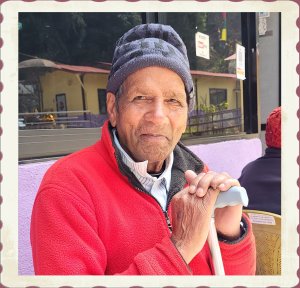
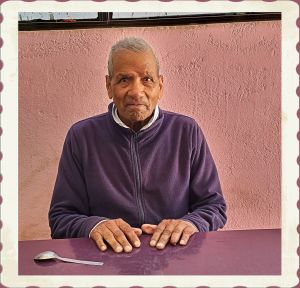
I’m not quite clear on what’s changed from last year to this year that would cause this change, but Padmal seems to be almost an entirely different man. As trite and emotionally manipulative as this may sound, I was moved to almost tears when he saw me for the first time this year and cracked a smile. He was so happy to see me every day, and smiled whenever I pointed the camera at him. He’s also walking better — actually better than he was walking last year. When I commented to Shaha about it, he looked as surprised as I was and agreed that, yes, Padmal was doing surprisingly well after his heart attack last year.
For many of the elders here, I become the child they never had, or the child they left behind. In Man Bahadur’s case, I was the daughter he lost when he left India, and so he took care of me the only way he knew how — by cleaning my room and the doorway outside it each day.
Padmal Singh also left children behind in India.
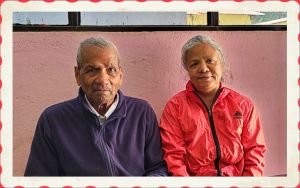
He left his family in India to come to Nepal to earn a living. I don’t know if he lost touch with them, if he ever sent money home, or if he simply abandoned them. I do know that he met Sahrda at a garment factory, fell in love, and married her. They did not have children together.
So perhaps Padmal, upon seeing me again, and realizing I had returned to him, saw me as a substitute daughter. Perhaps this is why he paused in his walk, every time he saw me, every morning and every evening, to put his hands together in greeting and smile.
After Man’s death, I dropped everything in Kathmandu, cancelled my plans, barked out orders to people, and rushed back to Pharping. I needed to be with my family there, and they needed me, as it turns out.
When Padmal saw me that afternoon, he put his hands together in greeting, and mustered a sad smile. His eyes said it all.
The day before I left Pharping for the last time this year, the day I explained to people, “Bholi bihani, eghara bajye, ma kathmandu jhanchu,” — “Tomorrow morning, noon, I go to Kathmandu” — I felt so much sadness from the elders. Padmal, hearing the news, just looked down at the ground, and walked away. I didn’t quite recognize his emotions until I was walking up the back driveway the next morning.
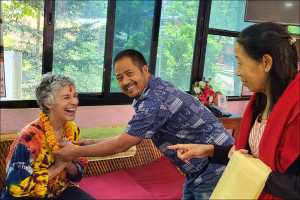
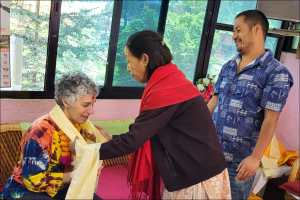
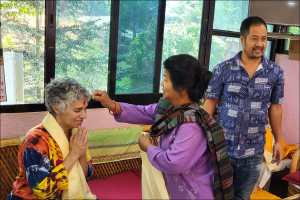
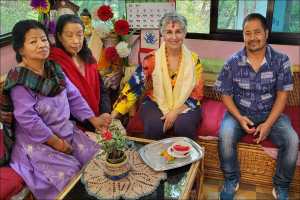
The next morning, Shaha, Pushpa and Beena, gave me blessings of tikas, placed garlands of marigolds around my neck for good luck, draped scarves of honor around me. We laughed, we got weepy, we had our photos taken.
At the end of all this, Shaha walked me up the back driveway, towards my waiting taxi. As we walked, he said, “The elders are all inside their rooms.”
I nodded. Not all Nepalis are big on saying goodbye.
But as I loaded up my backpack and carryall, out from the back of the dorm building came Saani, Sahrda didi, and Padmal. They walked up the steep steps to the back driveway to say goodbye. Saani couldn’t speak she was so choked up. Sahrda didi hugged me tightly for a long time, then tucked a chocolate truffle in my right hand and closed my fingers around it.
And then there was Padmal. He looked at me and I saw tears in his eyes. He held his hands up before him and just didn’t say anything. I clasped his hands in mine and brought them to my forehead in a sign of respect, and choked back my own tears.
Perhaps Padmal was watching his substitute daughter leave again.
Perhaps, given Man Bahadur’s death and his own frail health, he realized it may be the last time we see each other.
I can’t tell you which came first — my love for these elders or their love for me. I can’t tell you why I adore every one so deeply, and why I so easily form a bond with almost every elder that stays with us. I can’t tell you any of that.
I can tell you that I love what I do. It’s not work. It’s not a job.
I’ve been told it’s my calling.
♥
“The only answer for me…is love.” ~ John Lennon