‘Tis the rainy season in Nepal.
It’s kind of hard to imagine that a country high up in the Himalayan mountains could have a monsoon season, but it’s true. And every year, these monsoon rains have been hitting the country harder and harder.
Here’s an example: In 2019, I interviewed a 96-year-old man in Beltar (the remote, Tamang village where we work with elders). At that time, he recalled the estuary running through the village becoming a stream that one could just step over during monsoon season when he was a child. Now, it becomes a raging river that’s hard to navigate for several months a year.
That same year, as we traveled with millions of others out to the far reaches of the valley for Dashain, traffic was stopped for hours as vehicles navigated, one by one, across a section of road that had been overrun with rocks and water. That was in October, after the monsoon rains had stopped. At least, the monsoon rains were supposed to have stopped by then.
In Pharping, we’ve long known that the monsoon rains threaten the corner of the dormitory building as a landslide creeps closer every summer. This year, while the dormitory building is still standing, the devastation around the elder care home is hard to look at. It’s something off the evening news.
At the end of September, the heaviest rains this area has seen struck with fury, causing landslides, wiping out roads and hillsides, and leaving chaos in its wake.
Across the area, approximately 200 people are dead, 200 more are injured, and nearly 100 are missing.
I’ve spent the last few days checking in with everyone in Nepal, and with my friend, Suzie, who still has her contacts there from her days as a Peace Corps volunteer.
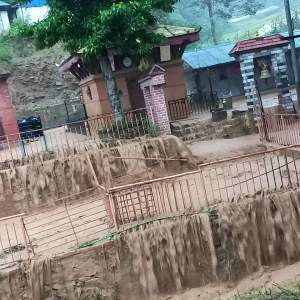
That’s muddy water rushing down the hillside and through the local temple in the market in Pharping, then over the walls and walkways.That’s not some weird growth.
Vehicles are still trapped in several feet of mud and rock on the main road. It happens that fast.
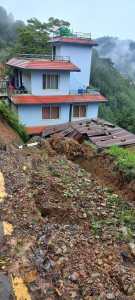
See that blue house above? I watched it being built. I arrived last year, went on my walk on the hills above the elder care home and said, “Oh, wow. They finally painted it!” The house next to it is gone. Gone.
These landslides have wiped out crops and killed livestock as well as people. The cost of food is already skyrocketing.
Our plan is to host a community dinner for all the elders in Pharping once a month. This will be outrageously expensive — more expensive than hosting dinners here in the US. Why? Because food costs and the cost of meat have jumped that high. We’re looking at nearly $100 per elder if we want to serve a proper dinner with meat.
We’ll find a way to do it.
Stay tuned.
♥