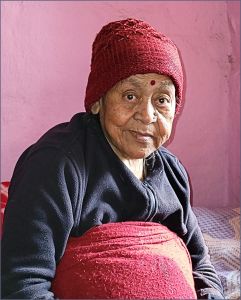
So, the officers showed up at her son’s home and reminded him of the law that requires him to provide care for his parents. When I heard this, I was thinking the same thing you’re thinking: Law?!
Here’s how the law works:
Because the family property passes to the oldest son, the oldest son is therefore required by law to care for his parents in their old age. This is also why the oldest son usually remains at home instead of moving out on his own, and why he raises his family in the home. If he becomes neglectful of this responsibility, charges can be brought against him for parental neglect.
Clearly, based on what we’ve seen with these elders in the past, this law is regularly flaunted, and enforcing it is far more complex than we can grasp as non-Nepalis.
The growing problem of keep Bishnu Aama safe
Bishnu Aama (“Black Aama” from the book) has been increasingly saying she wants to go home to her village and that if no one will take her, she’ll just leave the elder care home and go by herself.
Normally, we can redirect this behavior in dementia care settings because it commonly occurs as a symptom of “sundowning.” When a resident says he or she wants to go home, we’ll point to the time and say it’s too late, we’ve got everything planned for tomorrow, and give the resident an excuse tailor-made to him or her. It frequently works.
In Bishnu Aama’s case, though, she is saying this regularly throughout the day and evening. It’s not a case of sundowning, and it isn’t all that unusual.
As administrators and employees of assisted living, dementia care wards, and elder care in general, we have a responsibility to keep our residents safe. If a resident of an assisted living home wanders off the property, with the intention of “going home” or just going somewhere different, we have the obligation to notify the police and the state that we had an elopement.
In Pharping, the fear of Bishnu Aama walking off the property is very real. She is capable of walking up the hill and opening the gate and just leaving, and we can’t keep an eye on everything all the time. Is she capable of finding her way to her village? No, she isn’t. If she does walk off the property and is found by villagers, then it’s on Shaha for not keeping her safe.
This is where I admit the call to the police can seem confusing
Bishnu Aama is in Shaha’s care, yes, but the responsibility doesn’t fall solely on him. Because her son is now back in Nepal, he is required to assist as much as possible, but has refused.
Shaha reported him to the ward office because he felt he needed support with Bishnu Aama’s increasing behavior. Since Shaha can never get her son to cooperate with her care, he took the drastic measure of reporting her son to the authorities as a way to protect himself, his employees, and the elder care home — and to get her son’s attention.
Let me start by saying that Bishnu Aama’s son is in a bit of a bind, as is anyone child of a parent with dementia. Without commenting on his neglect, I will say that dealing with someone who wants to go home, when there is no home to return to, is challenging both mentally and emotionally.
So I’m not going to fault him for avoiding her insistence on going home. Dealing with it head-on just doesn’t work, either, and only ends up in an endless loop of frustration. So he’s in a no-win situation, really.
The police showed up at his door
And reminded him of his responsibility. They gave him a period of time to show up at the elder care home, or to call Pushpa or Shaha (I couldn’t catch how long they gave him from Shaha’s conversation).
He called the elder care home on Sunday, April 7, and said he would come out on Monday, pick up his mother, take her to her village to visit, and then bring her to his home to stay for a while.
On Monday, April 8, Shaha and I were sitting in the office of Jini Thapa, the administrator for Aloki Care Home, where Nanicchori is receiving her therapy (I promise to send an update soon — she’s doing great, and lit up when she saw me — even got teary-eyed and hugged me when the therapist wheeled her into the office). Shaha told me that Bishnu Aama’s son was picking her up this morning and doing all this. He said her son will arrive between “das and egarah bajye” (ten and eleven o’clock).
I slowly shook my head. “He will not do this,” I said. Shaha looked surprised. He takes everyone at their word. I’m a wee bit more realistic (skeptical?). Jini even looked at me, and I said, “No, this does not happen today.”
Then, I rattled off all the problems with this idea: 1. She can’t get into a car; 2. She can’t handle a 3-1/2 hour drive to her village in a car; 3. She will tell him he’s going the wrong way and drive him crazy; 4. If they do ever actually arrive at her village, she’ll announce that it’s not her village; 5. She will not want to stay with him, and he will not want her to stay with him.
Jini nodded, and Shaha thought about this. He said, “So what do I do if she wants to come back to live at the elder care home.”
I replied, “You take her back!” I reminded him that, as caregivers of our vulnerable adults, we are responsible for their safety and for their well-being. Living with her son is not best for her, so if it doesn’t work, Shaha must take her back, even if she is unhappy here.
Then I added that it wasn’t going to happen, anyway.
Her son called us at noon to say he would arrive between 4:00 and 5:00 p.m. instead.
At 5:30 p.m., he pulled up on his motorcycle. (Motorcycle!) A short, heated discussion ensued with his mother, during which he told her he would take her the next day. Then he spent an hour with Pushpa, talking with her and having milk tea (that’s just what we do here whenever we sit to talk…we have milk tea).
The next day, he arrived and another heated discussion ensued. This time Pushpa sat in the room to moderate. He told his mother he couldn’t take her to her village right away, and that it would have to be in a few days.
That is the last we’ve seen or heard from him and it’s been about a week.
Shaha’s complaint is that her son needs to communicate with Pushpa and with him. They need to know what support her son can provide, and need him to be more involved with her care. The son refuses to do anything — he never answers their questions or comes to visit his mother even on holidays. We doubt we’ll see him again for a very long time.
Bishnu, in the meantime, has been mildly cranky, but manages a smile for me whenever I coax her (that’s the extent of her smile in the photo above). She continues to tell us, “I’m dying. I want to die in my village. I want to die in my home in my village. I do not want to stay here.”
And we, in the meantime, are stuck in that familiar spot known to everyone who’s ever worked with dementia patients: We can’t take her to her physical home; we can only be with her as she makes her way to her soul’s home.