
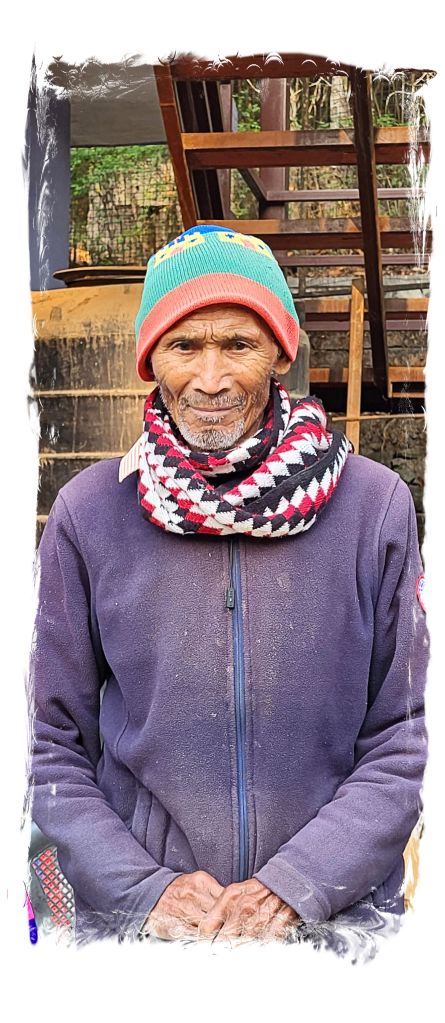
It is with an extremely heavy heart, that I tell you Mann Badhu has passed away, peacefully, from this earth.
He died quietly on Saturday night, at 10:50 p.m., Kathmandu time, with Shaha by his side. I was on my way back from Beltar, exchanging texts with Shaha all the way.
The stories I share of our elders’ lives are abridged. Readers don’t always want to know, nor do they need to know, all the details.
Man Bahadur’s (how to spell his name properly in Nepali) full story, though, is one I would like to share with you.
He met his wife here in Nepal when they were very young, and they traveled together to India to live and work. They made a life together there, having one son and one daughter, both of whom grew up to be successful in life.
When families separate and move to different countries, it’s easy to lose touch. If you’re rich, and you can afford cell phones and know how to keep in touch, that’s great. Man and his wife weren’t rich, and didn’t have cell phones. When they left India to come back to Nepal and retire on Man’s family property, they left their children behind, in the hopes of contacting them again in the future after they’d gotten settled.
As soon as Man’s wife realized he had been declared legally dead, and therefore could not collect a pension, she left him.
In those moments, he had truly lost everything.
During our interview last year, with Shaha and me, I had told Man Bahadur that I loved him like my own father, and a spark lit inside of him. The next morning, he dusted the outside of my doorway and my window, then came in and dusted the inside of my window, then sat down and just looked around. Every morning after that, he cleaned the outside of my room.
This year, every time he saw me, he asked if I’d had tea or food. That’s what Nepalis do when we want to show we care: We ask if the other person has had tea or has eaten. He always mustered a smile for me, and wanted to look good for the camera whenever I took a photo of him, first straightening his cap, and then asking me how he looked.
Shaha was back at the hospital at 4:00 a.m. today, making the arrangements for the funeral at Pashupatinath, the massive, sprawling temple grounds that contain the local funereal grounds. (That link goes to Britannica.com.) I met him there at 7:00 a.m.
Together, we stood by the boxy, white vehicle that served as a hearse, and watched as Shaha’s friends gently lifted Man’s body, wrapped in linen, then draped with orange fabric, off the gurney in the hearse, and onto another metal stretcher. They took him to an open area where visitors typically pay their last respects.
Then, Shaha and his friends left me alone while I sobbed over Man.
When it was time, they brought him inside the building and transferred him to a bamboo gurney on a rolling bed. The four of us had our last chances to drape more honorary orange fabric on him, to drop five-rupee notes on him to send him off with some money to spend, and red carnations for good luck. After we had said our last goodbyes, he was wheeled into the crematory furnace.
The door closed, and he was gone.
He had a pauper’s funeral.
I am forever grateful to Shaha for being there with Man until the end. I am forever grateful to Beena, Gyani, Ratna and Pushpa for loving him and being his family these last couple of years. And I am forever grateful to have known this quiet, gentle man who suffered in ways we will never know.
Thank you all for being on this journey with me, and thank you all for your love and support. I may not reply to every email right away, but I do read them all.
Love you all,
Alicia
During our interview last year, with Shaha and me, I had told Man Bahadur that I loved him like my own father, and a spark lit inside of him. The next morning, he dusted the outside of my doorway and my window, then came in and dusted the inside of my window, then sat down and just looked around. Every morning after that, he cleaned the outside of my room.
Together, we stood by the boxy, white vehicle that served as a hearse, and watched as Shaha’s friends gently lifted Man’s body, wrapped in linen, then draped with orange fabric, off the gurney in the hearse, and onto another metal stretcher. They took him to an open area where visitors typically pay their last respects.
Love you all,