
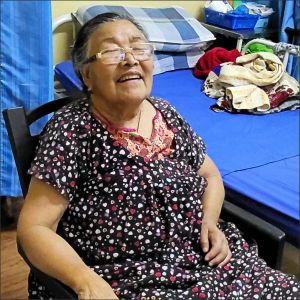
Nanicchori is doing well.
We have a tough road ahead of us, and many things are uncertain, but she’s doing quite well for her age and circumstances.
Shaha and I had the opportunity to visit with Nanicchori the other day, and she was happy to see us both. Hugging isn’t big in Nepal, but I seem to bring out the hugger in people. Nanicchori has hugged me both times I’ve seen her in therapy, and never considered doing that before her stroke.
She was in her room, on a little bicycle exerciser — the very basic type, where you can sit in your favorite lounge chair and pedal away. The therapist had tied her left foot to the pedal to keep it on, and her assignment was to pedal 200 times. She made it to 200, but it was a challenge for her.
We all talked about how she had a bicycle when she was younger. This was very unusual in those days. Only wealthy families could afford bicycles, and it was frowned upon for young girls to ride one. That didn’t stop Nanicchori. She rode her bicycle all around her village in Kathmandu, and all her friends told her how jealous they were that she had one.
We have a tough road ahead of us, and some difficult decisions to make. Nanicchori has always had excruciating pain from arthritic knees, and her toes are crossed from bunions. She can stand for a count of 200, but after that the pain in her knees becomes too much and she has to sit down. Inactivity from the stroke isn’t helping, but at her advanced age, there’s nothing we can do about this.
Her care at the Aloki Care Home is nearly $20 per day. That sounds like nothing, but in rupees, it’s a lot, and she’s been there for five months already. Plus, Shaha still has the hospital bills to pay off. Nanicchori’s daughters have both recently told Shaha they can’t afford to send any money for her care, so Shaha took a bold step during our visit. He asked Nanicchori to call her other family members, many who are wealthy, to ask for their help.
Because I’m steadfastly against mission creep in this nonprofit, we are unable to pay her medical bills directly. We focus on food and housing only. I can do other things to support Shaha, however, as he struggles with this financial burden:
-
I can increase my monthly support for the elder care home to relieve him of any additional financial burdens there (the Nepal-allocated proceeds from last year’s Black Friday Sale are being used this way);
-
I can plan a fundraiser here in Kathmandu for Nanicchori’s medical bills, the proceeds of which will go directly to Shaha’s nonprofit; and
-
I can plan additional fundraisers back in the States.