Today and tomorrow, I’ll introduce you to three more of my heroes: Two new friends, and one of my brothers whom you’ve heard me speak of frequently.
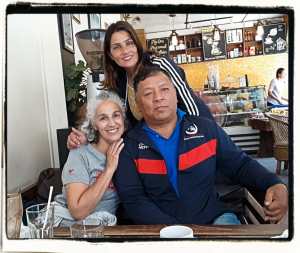
First, please meet Chhultim Sherpa and his wife, Sita Bhandari.
Okay, don’t ask me why we were leaning in this photo…we’d only been drinking coffee, not liquor…but somehow we ended up lopsided. Sita stands above us, hiding her left arm, and Chhultim is practicing not smiling.
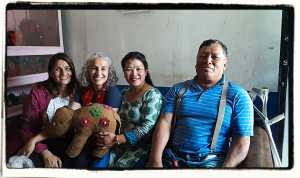
Below, we pack onto the small couch at the disabled center run by Chhultim, along with Chanda, the director of the center. No, I didn’t purchase this big, felt elephant — but I did purchase quite a bit of other goods for our booth on Black Friday.
Let’s follow the bouncing ball for a moment: Frank, in Switzerland, is our Guatemalan Project Director. A friend of his from Germany met Chhultim, and introduced him to Frank. In turn, Frank introduced me to Chhultim.
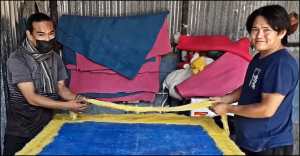
In addition to running the center for physically and mentally disabled persons, where they make felt goods by hand — including making the felt from scratch! — Chhultim also works with the Wheelchair Cricket Association of Nepal. If you look carefully at the photo above, you can see his crutches leaning against the side of the couch next to him. He gets around by leaning on his crutches and dragging his legs along with him. In Nepal, three-wheeled scooters are now popular, and Chhultim and Sita own one, as do several people at the disabled center. These scooters give disabled people in Nepal an entirely new independence.
At the home for disabled persons, they house 35 people. Only those with spinal cord injuries get assistance from the government, and it’s not very much. Everyone pitches in. Here, at their primary location, they make the beautiful and detailed felt goods, such as the elephant pictured above. At a second location, seamstresses (male and female) make high-quality clothing.
His wife, Sita, is a burn victim, and lost her left forearm in the blaze. She hides it in photos. Her goal is to create a home such as this disabled center for burn victims. The majority of those she would house are women: Most fires occur in the kitchen, when the countertop burners explode upon lighting. We use natural gas in Nepal, and I can say from experience that lighting these burners can be nerve-wracking some times.
As you’ve guessed by now, anyone with any type of disfigurement, disability, or basic physical difference in Nepal is generally shunned by society. I’ve only ever seen one man with a missing limb successfully holding a job — and that’s out in Sindhuli Bazar, a remote town in the valley.
There are very few people in this world with whom I feel an immediate, genuine affection at first sight. Chhultim and Sita are two of those people. They are authentic and kind in every way, and their kindness extends to those in their center who begin to age beyond the center’s ability to properly care for them.
This is how I ended up introducing them to Shahadev, the young man whose nonprofit runs the elder care home in Pharping. I’ve mentioned him often to all of you, and tomorrow I’ll formally introduce him to you as well.
Stay tuned!
Alicia Jean Demetropolis
The Global Humanity Initiative